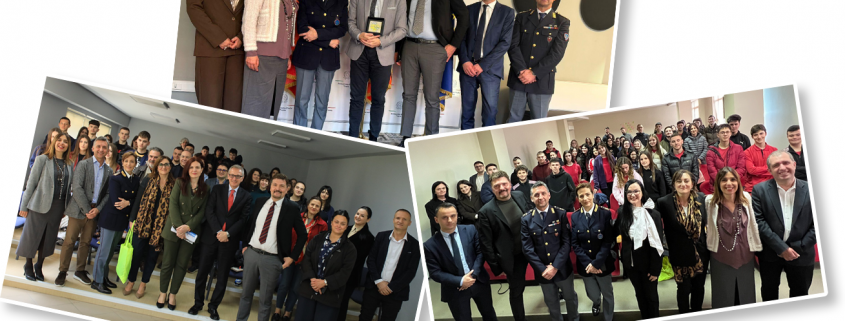
The mission of the EUVALWEB Legal Observatory to Tirana, Albania, under the direction of Professor Teresa Russo, brought together Italian and Albanian magistrates, lawyers, and representatives of the State Police, reinforcing long-standing institutional relationships while also fostering new and meaningful collaborations.

On March 24, the delegation met with the Italian Ambassador to Albania, His Excellency Marco Alberti. The discussion offered valuable insight into the evolving relationship between Italy and Albania, as well as the current state of Albania’s negotiations for accession to the European Union.

The following day, March 25, the international symposium on the Rule of Law at Epoka University created an important platform for dialogue among key stakeholders—including experts, policymakers, academics, and civil society representatives—emphasizing the shared commitment to building a stronger and more inclusive democratic society.

Also on March 25, the meeting at the School of the Judiciary in Tirana laid the groundwork for future cooperation, opening new avenues for joint initiatives in legal education and institutional exchange.

On March 26, a meeting held at the Tirana General Prosecutor’s Office with the Deputy Prosecutor General of the Albanian Court of Cassation marked an important step toward strengthening institutional cooperation and laid the groundwork for future joint initiatives.

This was followed by a mock trial at Ismail Qemali High School, centered on the emerging issue of deepfakes. The initiative offered students a valuable opportunity to engage in a meaningful discussion on the responsible and informed use of social media, fostering greater awareness of digital risks and ethical challenges.

The mission concluded, on March 27, with the projection of the short film “Imperfetta”, produced by Rai Cinema in collaboration with the Italian State Police, at Turgut Ozal High School. The film addressed the sensitive topic of stereotypes on social media, promoting respect for individual dignity and the value of uniqueness.

In conclusion, the EUVALWEB mission in Tirana represented an important opportunity for dialogue and shared growth, strengthening cooperation among institutions, academia, and civil society. The activities carried out helped promote the values of the rule of law, international cooperation, and digital awareness, with particular attention to younger generations.

The experience gained in Tirana provides a solid foundation for developing further joint initiatives, based on the belief that only through continuous collaboration and exchange, with active involvement of all stakeholders, can a more just, inclusive, and aware society be built.

Link to the pictures: https://www.facebook.com/media/set/?set=a.1470990184817526&type=3

The EUVALWEB Legal Observatory at the Department of Legal Sciences of the University of Salerno arrived to Tirana, Albania, with the project “A Network of Safety in Europe” – Second Edition, carried out in collaboration with the National Magistrates Association – District of Salerno, the State Police, the autonomous body Giffoni Experience, and the Bar Association of Salerno. The project includes a series of initiatives involving academics, professionals, university and school students, and Albanian civil society.

Specifically, on March 25, an international symposium entitled “The Rule of Law at the Frontline of EU Integration in the Western Balkans” will take place. The participation of academics, judges, law enforcement officers, political and institutional representatives, and NGOs will provide an opportunity to examine respect for the rule of law—between legal frameworks and practical implementation—in the Western Balkans. Flyer: https://euvalweb.euweb.org/wp-content/uploads/2026/03/2026-3-25-The-Rule-of-Law_Scientific-Symposium-compresso.pdf
On March 26, at the General Prosecutor’s Office of Tirana, an Interinstitutional Meeting on the Evolution of Italian-Albanian Judicial Cooperation will be held, bringing together academics, Italian and Albanian magistrates, and the Italian Embassy in Tirana. The meeting aims to foster the exchange of best practices, expertise, and operational skills in the field of criminal justice and judicial cooperation among professionals across Europe.
This will be followed by a mock trial on the crime of deepfake at the “Ismail Qemali” High School, aimed at raising awareness among younger generations about the criminal risks and legal consequences associated with the improper use of social networks. Flyer: https://euvalweb.euweb.org/wp-content/uploads/2026/03/2026-3-26-Flyer-EUVALWEB-Mock-Trial.pdfFinally, on March 27, at the “Turgut Ozal” High School, the socio-cultural initiative “Cinema and Law” will take place, featuring the screening of the short film “Imperfetta”, produced by the Italian State Police in collaboration with Rai. Political representatives will also participate, engaging in discussions with young people on the concept of body neutrality. Flyer: https://euvalweb.euweb.org/wp-content/uploads/2026/03/2026-3-27-EUVALWEB-Cinema-and-Law.pdf

There will also be informal meetings at the Albanian School of Magistracy, as well as between Italian and Albanian police forces.

We are truly satisfied with the work carried out and what lies ahead.

Iceland will hold a referendum on Aug. 29 to decide whether to relaunch its stalled talks to join the EU, its government said Friday. A resolution is expected to be presented to Parliament next week, according to Minister for Foreign Affairs Kristrún Frostadóttir.

The Arctic country applied for EU membership in 2009 amid a financial crisis but froze talks in 2013 after a dispute over fishing policy and formally withdrew its application in 2015. Currently, Iceland is a member of the European Economic Area and part of the Schengen free travel area.

Official press release from the Government of Iceland: HERE

EUWEB Legal Essays: Global & International Perspectives, classified by ANVUR as scientific review for area 12, is pleased to invite submissions for the upcoming Issue 2/2026, which will be published on July 31, 2026.

We welcome submissions that fall within the Journal’s broader scope, particularly those that address the Union’s enlargement and future prospects, its external borders and action, and neighbourhood, cross-border security, migration and asylum, the fight against transnational crimes, police and judicial cooperation, the promotion and protection of the Unionì’s values, and the fundamental rights of all individuals.

Everybody interested is invited to submit a paper in one of the following categories:
1) Essay: may discuss a broader theme; requires adequate references and footnotes; needs to be supported with an in-depth study of legal acts, literature and case-law; peer reviewed (min 7,000 words, footnotes included).
2) Comment: dwells on a more limited topic; requires adequate references and footnotes; needs to be supported with an in-depth study of legal acts, literature and case-law; peer reviewed (min 6,000 words, footnotes included).
3) Focus:  reserved for professionals; provides a technical perspective on a certain matter; footnotes
or references required; peer reviewed (min 3,000 words).
4) Conference speech: reproduces and expands a speech/presentation already held in a scientific event; no footnotes or references required; not peer reviewed (min 3,000 words).

The deadline for submitting the title and a short abstract (max 250 words) is April 12, 2026. The full article, in conformity with attached editorial criteria, must be submitted by June 5, 2026, to allow for double-blind peer review.

Submissions should be addressed to info@euweb.org.
For further information, please visit the official website at: https://www.euweb.org.