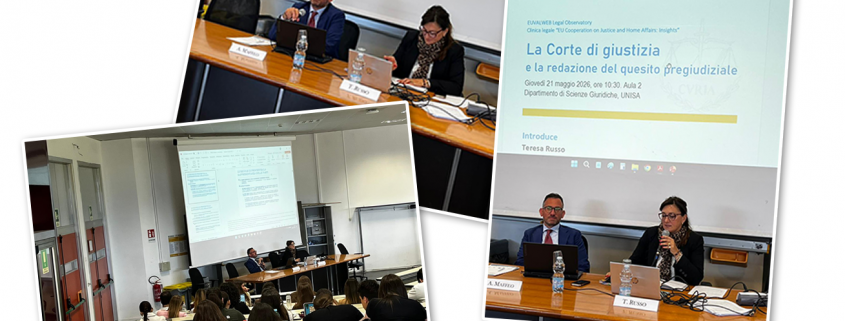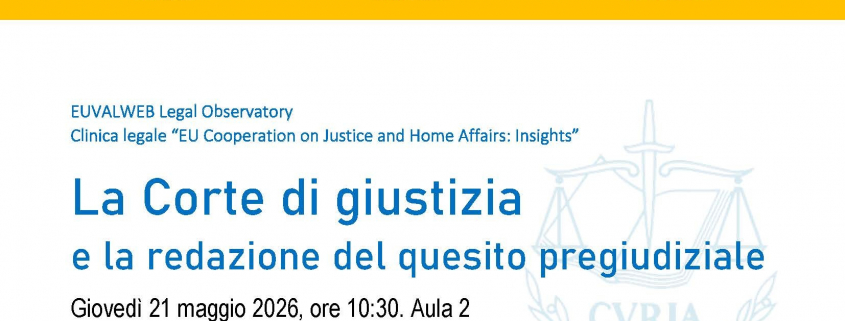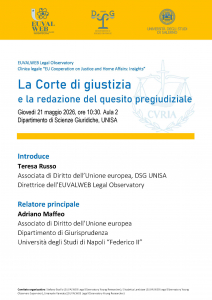
On Thursday, 21 May 2026 at 10:30 a.m., in Room 2 of the Department of Legal Sciences at the University of Salerno, the seminar entitled The Court of Justice and the Drafting of the Preliminary Reference will take place as part of the activities promoted by the EUVALWEB Legal Observatory and the Legal Clinic “EU Cooperation on Justice and Home Affairs: Insights”.

The event will provide an important opportunity to explore the role of the Court of Justice of the European Union and the techniques involved in drafting a preliminary reference, a key instrument in the judicial dialogue between national courts and the European jurisdiction.

The seminar will be introduced by Teresa Russo, Associate Professor of European Union Law at the Department of Legal Sciences of the University of Salerno and Director of the EUVALWEB Legal Observatory.

The keynote speaker will be Adriano Matteo, Associate Professor of European Union Law at the Department of Law of the University of Naples Federico II.

The initiative is part of the educational activities of the Legal Clinic devoted to European cooperation in the fields of justice and home affairs, with the aim of providing students, researchers, and young scholars with practical and theoretical tools to better understand the functioning of the European Union judicial system.

For further information, check out the flyer.

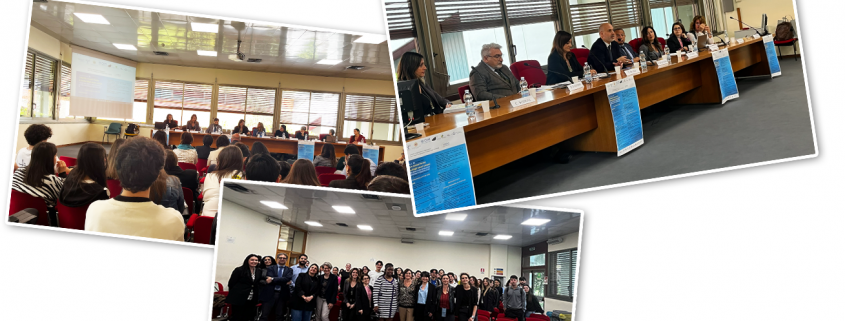
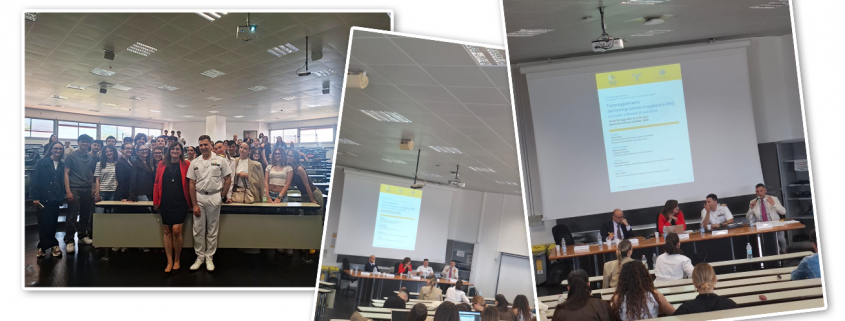
Critical Issues and New Forms of Human Trafficking: Protecting Victims in View of the Implementation of the European Union Pact on Migration and Asylum” was an intense and highly participatory study day that brought together institutions, members of the judiciary, law enforcement authorities, academics, third-sector organizations, and students at the University of Salerno to reflect on the new challenges posed by human trafficking.

Throughout the discussions, participants strongly emphasized the urgent need to strengthen mechanisms for the early identification and protection of victims, especially in light of the evolving nature of trafficking, which is becoming increasingly hybrid, invisible, and digitalized. Particular attention was devoted to the risks connected to the implementation of the new EU Pact on Migration and Asylum, especially regarding border procedures and accelerated return mechanisms, which may affect the ability to promptly identify situations of exploitation.

The technical roundtable fostered a constructive dialogue between theory and practice, enabling the sharing of experiences, operational challenges, and best practices, with the common goal of developing more effective tools for the protection of fundamental rights.

Equally significant was the session dedicated to students, which provided an important opportunity to raise awareness and deepen understanding of a phenomenon that often remains hidden. Through thematic contributions, audiovisual materials, and testimonies, the initiative encouraged critical reflection and greater awareness.

The event concluded with a shared commitment to continue strengthening cooperation among institutions, academia, and sector professionals, in the awareness that combating human trafficking requires multidisciplinary approaches, strong collaboration, and policies increasingly centered on the protection of human dignity and victims’ rights.

Pictures of the event are available HERE!

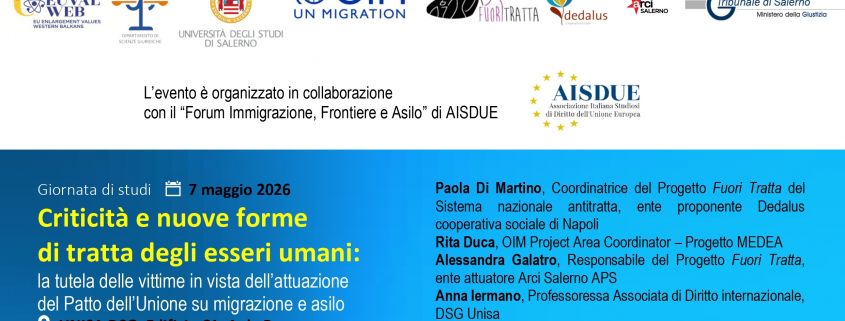
On 7 May 2026, the EUVALWEB Legal Observatory will promote, at the Department of Legal Sciences of the University of Salerno, a study day entitled “Critical Issues and New Forms of Human Trafficking: Victim Protection in Light of the Implementation of the EU Pact on Migration and Asylum”, to be held in Aula Pecoraro.

The initiative aims to provide an updated and interdisciplinary analysis of human trafficking, a phenomenon that is increasingly complex, hybrid, and digitalized, particularly in light of recent developments in European and national legislation. Special attention will be paid to the implications arising from the implementation of the new EU Pact on Migration and Asylum, including the risk of the “invisibilization” of victims within border procedures, screening processes, and accelerated return mechanisms.

The event will be structured in two main sessions.

The technical roundtable (9:30 a.m. – 1:00 p.m.) will bring together representatives from institutions, the judiciary, law enforcement agencies, academia, and civil society organizations. The discussion will focus on identifying operational challenges and sharing best practices to strengthen early identification, protection, and assistance mechanisms for victims, while ensuring full respect for fundamental rights. Key topics will include the evolution of trafficking, the use of digital technologies, the intersection between trafficking and migrant smuggling, challenges in victim identification procedures, and the impact of European migration policies.

In the afternoon (2:30 p.m. – 4:30 p.m.), a session with students will aim to raise awareness of the most current and less visible forms of human trafficking. Through thematic presentations, audiovisual materials, and testimonies, the session seeks to foster critical reflection, promote a culture of human rights, and counter stereotypes and misinformation surrounding migration.

This event represents an important opportunity for dialogue between theory and practice, with the goal of formulating operational recommendations and policy proposals to improve the implementation of European and national anti-trafficking frameworks.

Participation is open to scholars, practitioners, students, and all those interested. It will be possible to participate online by registering at the following link https://euvalweb.euweb.org/registration/

The working language will be Italian.

For further information give a look at the agenda and the flyer (IT):

Agenda http://euvalweb.euweb.org/wp-content/uploads/2026/05/DEF-EUVALWEB-7-maggio-2026-Agenda-Tratta-1.pdf

Flyer http://euvalweb.euweb.org/wp-content/uploads/2026/05/DEF.-Locandina-EUVALWEB-giornata-lotta-alla-Tratta.pdf

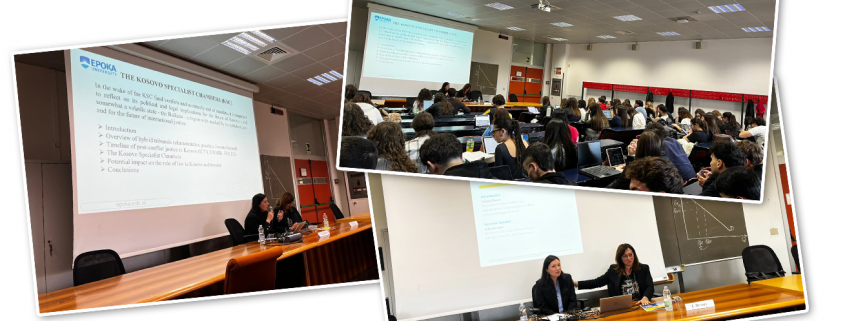
Yesterday was a particularly productive day for the students of the European Union Law course. Thanks to Professor Alba Gerdeci, they explored the historical background of Kosovo and the complex legal challenges related to prosecuting serious crimes arising from the 1998–2000 conflict.

A central focus was the role of the Kosovo Specialist Chambers (KSC), which are closely connected to the broader effort to establish and consolidate the rule of law in Kosovo and other post-conflict societies. In particular, the discussion highlighted how the KSC contribute to ending impunity, addressing structural weaknesses in domestic judicial systems, and ensuring fair trial guarantees and the protection of fundamental rights, in line with standards such as the European Convention on Human Rights. Their establishment is also linked to the conditionality framework promoted by the European Union in the context of integration processes.

At the same time, the lecture addressed key criticisms: the perception that the KSC disproportionately target one side of the conflict, concerns about their external location and composition affecting local legitimacy, and the risk that reliance on international mechanisms may slow the development of domestic judicial capacity.
Together, these elements—both strengths and criticisms—represent essential considerations for the long-term development of a stable, credible, and locally trusted rule of law system.

Pictures of the day: https://www.facebook.com/media/set/?set=a.1499709138612297&type=3

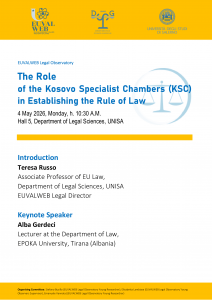
On Monday, 4 May 2026, at 10:30 a.m., Hall 5 of the Department of Legal Sciences at the University of Salerno will host the event entitled “The Role of the Kosovo Specialist Chambers (KSC) in Establishing the Rule of Law”, organized within the framework of the EUVALWEB Legal Observatory activities.

The initiative represents an important opportunity to explore a topic of great relevance in the international legal landscape.

The event will be introduced by Professor Teresa Russo, Associate Professor of European Union Law at the Department of Legal Sciences, University of Salerno, and Founder and Director of EUVALWEB Legal Observatory.

The keynote speaker will be Alba Gerdeci, Lecturer at the Department of Law at EPOKA University in Tirana (Albania).

The event is part of the research and dissemination activities of the EUVALWEB Legal Observatory, aimed at promoting academic and institutional debate on European Union values and the consolidation of the rule of law in the Western Balkans.

The event is open to students, scholars, and all interested participants.

For further information, please refer to the flyer.

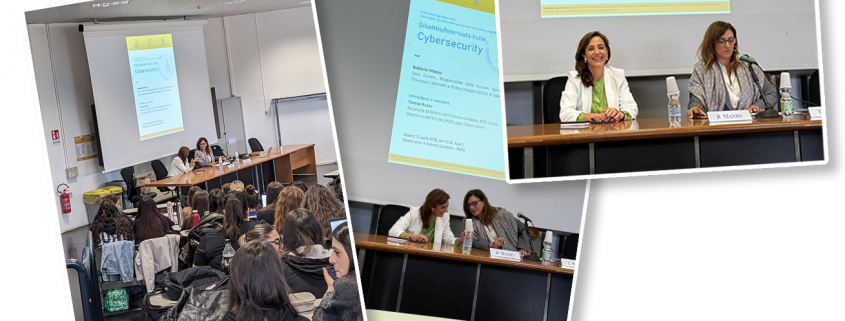
The cybersecurity debate/interview sparked great interest among students in the UNISA courses of EU Law (Dpt. of Legal Sciences), International Law, Cybersecurity and Artificial Intellicence (Dpt. of Business Sciences – Management & Innovation Systems), European Union Values, Integration and Migration Law (Dpt. of Legal Sciences), as well as the law clinic in EU Cooperation on Justice and Home Affairs: Insights (Dpt. of Legal Sciences).

Many were the questions that Dr. Manzo was called upon to answer, confirming the relevance and timeliness of the topics discussed.

Here are some pictures from the event: https://www.facebook.com/media/set/?set=a.1496526115597266&type=3