
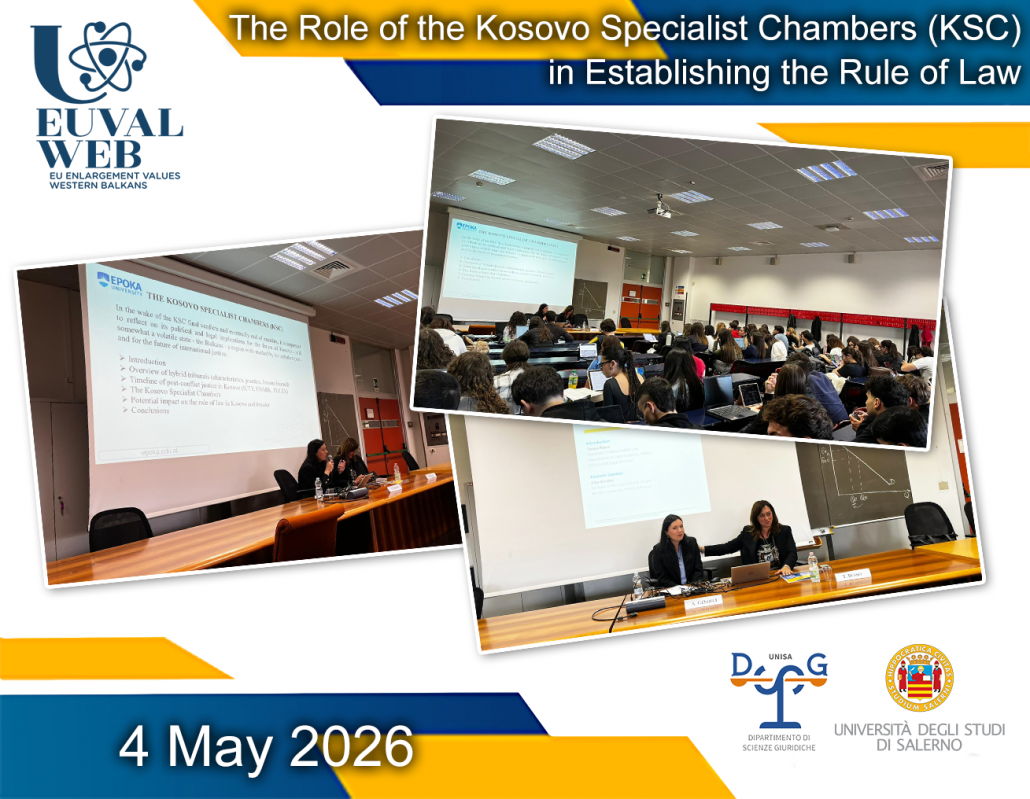
Yesterday was a particularly productive day for the students of the European Union Law course. Thanks to Professor Alba Gerdeci, they explored the historical background of Kosovo and the complex legal challenges related to prosecuting serious crimes arising from the 1998–2000 conflict.
A central focus was the role of the Kosovo Specialist Chambers (KSC), which are closely connected to the broader effort to establish and consolidate the rule of law in Kosovo and other post-conflict societies. In particular, the discussion highlighted how the KSC contribute to ending impunity, addressing structural weaknesses in domestic judicial systems, and ensuring fair trial guarantees and the protection of fundamental rights, in line with standards such as the European Convention on Human Rights. Their establishment is also linked to the conditionality framework promoted by the European Union in the context of integration processes.
At the same time, the lecture addressed key criticisms: the perception that the KSC disproportionately target one side of the conflict, concerns about their external location and composition affecting local legitimacy, and the risk that reliance on international mechanisms may slow the development of domestic judicial capacity.
Together, these elements—both strengths and criticisms—represent essential considerations for the long-term development of a stable, credible, and locally trusted rule of law system.
Pictures of the day: https://www.facebook.com/media/set/?set=a.1499709138612297&type=3