Cinema & Law: EUVALWEB Legal Observatory brings the Debate on Body Neutrality and Fundamental Rights to the Giffoni Film Festival
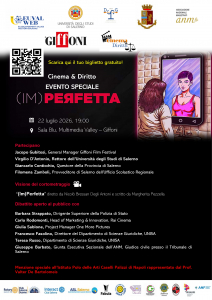
On 22 July 2026, at 7:00 p.m., the Blue Hall of the Multimedia Valley at the Giffoni Film Festival will host the special event “Cinema & Law”, organised by the EUVALWEB Legal Observatory of the University of Salerno, in collaboration with the Department of Legal Sciences, University of Salerno, the State Police and the Magistrates’ National Association.
The initiative reflects the Observatory’s ongoing commitment to promoting the values of the European Union by fostering dialogue on fundamental rights, equality, human dignity, inclusion, and European citizenship through innovative and interdisciplinary approaches. By combining legal scholarship with the powerful language of cinema, the event seeks to engage young people and the wider public in addressing contemporary social challenges while promoting a culture of respect, diversity, and non-discrimination.
At the heart of the event is the screening of the award-winning short film (Im)Perfetta, directed by Nicolò Bressan Degli Antoni and written by Margherita Pezzella. The film offers a compelling reflection on body neutrality, encouraging audiences to move beyond unrealistic beauty standards and social stereotypes towards a vision of the individual grounded in dignity, self-acceptance, and respect for human diversity. Rather than defining personal worth by physical appearance, (Im)Perfetta highlights the importance of recognizing that every person deserves equal respect and equal opportunities.
The screening will be followed by an interdisciplinary panel discussion bringing together representatives from academia, public institutions, the judiciary, law enforcement authorities, and the audiovisual industry. The discussion will examine body neutrality not only as a cultural and educational issue but also as a matter closely connected to fundamental rights, including the rights to dignity, equality, and non-discrimination, to mental well-being, and to the protection of children and young people from harmful stereotypes and social pressures. Particular attention will be devoted to the role of audiovisual storytelling in fostering awareness, encouraging critical thinking, and promoting a more inclusive and respectful society.
Institutional greetings will be delivered by Jacopo Gubitosi, General Manager of the Giffoni Film Festival; Virgilio D’Antonio, Rector of the University of Salerno; Giancarlo Conticchio, Chief of Police of the Province of Salerno; and Filomena Zamboli, Head of the Provincial School Office of Salerno.
The panel discussion will feature Barbara Strappato (Italian State Police), Carlo Rodomonti (Rai Cinema), Giulia Sablone (One More Pictures), Francesco Fasolino, Director of the Department of Legal Sciences of the University of Salerno, Teresa Russo, Director of the EUVALWEB Legal Observatory, and Giuseppe Barbato, Member of the National Magistrates’ Association and Judge at the Court of Salerno.
During the event, a Special Mention will be awarded to the Polo delle Arti Caselli Palizzi of Naples, represented by Professor Valter De Bartolomeis, in recognition of its outstanding contribution to artistic education and the promotion of civic values among younger generations.
Through initiatives such as Cinema & Law, the EUVALWEB Legal Observatory reaffirms its mission to advance knowledge and public awareness of the European Union’s fundamental values by connecting legal research with culture, education, and civic engagement. By addressing body neutrality through the lens of fundamental rights, the event demonstrates how interdisciplinary dialogue can help combat discrimination, empower young people, and strengthen a more inclusive, rights-based, and participatory European society.



Call for Papers Issue 1/2027 – 30 September 2026
EUWEB Legal Essays. Global & International Perspectives invites scholars and professionals to submit contributions for its forthcoming Issue 1/2027, to be published on January 31, 2027.
The Journal welcomes original contributions on key issues at the intersection of EU, international and global legal developments, including: EU enlargement and its future; External action and neighbourhood relations; Cross-border security and transnational crime; Migration, asylum and fundamental rights; Police and judicial cooperation; EU values and their protection.
Submission categories: Essay; Comment; Focus; Conference Speech
Deadline: October 19, 2026
Submit your title, abstract (max. 250 words), qualification and institutional affiliation.
Selected authors will be notified by October 26, 2026. Full articles will be due by December 5, 2026.
info@euweb.org
www.euweb.org
We look forward to receiving innovative and thought-provoking contributions to the debate on Europe’s legal and international challenges.
EUWEB LEGAL ESSAYS. GLOBAL & INTERNATIONAL PERSPECTIVES, NO. 2/2026 – July 2026
EUWEB Legal Essays. Global & International Perspectives, Issue 2/2026 is out (and completely free)!
The current issue, introduced by the Editorial of Andrea Cascone, features:
– essays by Marco Evola, Nina Madjovska Naumovska, Jelena Ristić, Alfredo Rizzo, Roze Surlovska Ristevska;
– a focus on the 2022 judicial map reform in Albania by Julinda Beqiraj and Edlira Osmani;
– conferences proceedings on the human trafficking thematic Conference of 7 May 2026 by Teresa Russo.
Go and check it out at the following link: https://www.euweb.org/euweb-legal-essays-2026-2/
Pictures of the day – 22 July 2026
Cinema & Law at the Giffoni Film Festival: A Successful Dialogue on Body Neutrality, Fundamental Rights and European Values
The EUVALWEB Legal Observatory proudly participated in the Giffoni Film Festival 2026 with the special event “Cinema & Law”, bringing together students, academics, public institutions, legal professionals, and representatives of the audiovisual industry to reflect on one of the most pressing challenges facing younger generations: body neutrality, digital identity, and the protection of fundamental rights.
The screening of the short film (Im)Perfetta, directed by Nicolò Bressan Degli Antoni and written by Margherita Pezzella, inspired a vibrant interdisciplinary discussion on human dignity, self-acceptance, online manipulation, and the impact of unrealistic beauty standards on adolescents. Through the lens of law, education, and cinema, participants explored how fundamental rights can provide a framework for promoting inclusion, equality, and respect for every individual’s identity.
A highlight of the event was the official launch of the Cinema & Law Contest, an initiative designed to encourage students to become active promoters of European values through creativity, critical thinking, and legal awareness. The contest invites young participants to reflect on contemporary social issues by using the language of cinema as a powerful tool for civic engagement and human rights education.
During the event, the EUVALWEB Legal Observatory was also honoured to present a Special Mention to the Polo delle Arti Caselli Palizzi of Naples, represented by Professor Valter De Bartolomeis, in recognition of the school’s outstanding commitment to artistic education and to fostering civic values, inclusion, and social responsibility among young people.
The enthusiastic participation of students and the richness of the debate confirmed the importance of creating spaces where law, culture, and education meet to address today’s social challenges. By encouraging young people to look beyond appearances and recognise the inherent dignity of every person, Cinema & Law reaffirmed the EUVALWEB Legal Observatory’s mission to promote the values of the European Union through dialogue, education, and interdisciplinary cooperation.
Let’s keep looking beyond appearances. Let’s keep looking into each other’s eyes.
Link to the pictures HERE!:
Special event “Cinema and Law” at Giffoni Film Festival – 22 July 2026
Cinema & Law: EUVALWEB Legal Observatory brings the Debate on Body Neutrality and Fundamental Rights to the Giffoni Film Festival
On 22 July 2026, at 7:00 p.m., the Blue Hall of the Multimedia Valley at the Giffoni Film Festival will host the special event “Cinema & Law”, organised by the EUVALWEB Legal Observatory of the University of Salerno, in collaboration with the Department of Legal Sciences, University of Salerno, the State Police and the Magistrates’ National Association.
The initiative reflects the Observatory’s ongoing commitment to promoting the values of the European Union by fostering dialogue on fundamental rights, equality, human dignity, inclusion, and European citizenship through innovative and interdisciplinary approaches. By combining legal scholarship with the powerful language of cinema, the event seeks to engage young people and the wider public in addressing contemporary social challenges while promoting a culture of respect, diversity, and non-discrimination.
At the heart of the event is the screening of the award-winning short film (Im)Perfetta, directed by Nicolò Bressan Degli Antoni and written by Margherita Pezzella. The film offers a compelling reflection on body neutrality, encouraging audiences to move beyond unrealistic beauty standards and social stereotypes towards a vision of the individual grounded in dignity, self-acceptance, and respect for human diversity. Rather than defining personal worth by physical appearance, (Im)Perfetta highlights the importance of recognizing that every person deserves equal respect and equal opportunities.
The screening will be followed by an interdisciplinary panel discussion bringing together representatives from academia, public institutions, the judiciary, law enforcement authorities, and the audiovisual industry. The discussion will examine body neutrality not only as a cultural and educational issue but also as a matter closely connected to fundamental rights, including the rights to dignity, equality, and non-discrimination, to mental well-being, and to the protection of children and young people from harmful stereotypes and social pressures. Particular attention will be devoted to the role of audiovisual storytelling in fostering awareness, encouraging critical thinking, and promoting a more inclusive and respectful society.
Institutional greetings will be delivered by Jacopo Gubitosi, General Manager of the Giffoni Film Festival; Virgilio D’Antonio, Rector of the University of Salerno; Giancarlo Conticchio, Chief of Police of the Province of Salerno; and Filomena Zamboli, Head of the Provincial School Office of Salerno.
The panel discussion will feature Barbara Strappato (Italian State Police), Carlo Rodomonti (Rai Cinema), Giulia Sablone (One More Pictures), Francesco Fasolino, Director of the Department of Legal Sciences of the University of Salerno, Teresa Russo, Director of the EUVALWEB Legal Observatory, and Giuseppe Barbato, Member of the National Magistrates’ Association and Judge at the Court of Salerno.
During the event, a Special Mention will be awarded to the Polo delle Arti Caselli Palizzi of Naples, represented by Professor Valter De Bartolomeis, in recognition of its outstanding contribution to artistic education and the promotion of civic values among younger generations.
Through initiatives such as Cinema & Law, the EUVALWEB Legal Observatory reaffirms its mission to advance knowledge and public awareness of the European Union’s fundamental values by connecting legal research with culture, education, and civic engagement. By addressing body neutrality through the lens of fundamental rights, the event demonstrates how interdisciplinary dialogue can help combat discrimination, empower young people, and strengthen a more inclusive, rights-based, and participatory European society.
Pictures of the day – 8 July 2026
Yesterday’s workshop was an inspiring opportunity for dialogue, knowledge sharing, and the development of future collaborations.
Each participant had the chance to present their academic courses, research activities, and scientific interests, creating a dynamic interdisciplinary exchange. By sharing expertise and experiences, we identified several common research areas and laid the groundwork for future joint projects and international scientific cooperation, while also reaffirming our commitment to supporting our Ukrainian colleagues during the difficult circumstances they continue to face.
Hosted within the framework of the EUVALWEB Legal Observatory’s Workshop on “Enhancing New Interdisciplinary Perspectives on EU Law with Ukraine” at the University of Salerno, the event highlighted the importance of strengthening academic dialogue between institutions and fostering meaningful partnerships across disciplines and countries.
A sincere thank you to all the speakers and participants for their valuable contributions, enthusiasm, and commitment to building new paths for research, innovation, and international cooperation. Together, we demonstrate that academic collaboration is not only a driver of scientific excellence but also a powerful expression of solidarity and shared values.
Some pictures of the day are available at https://www.facebook.com/media/set/?set=a.1556951569554720&type=3
Enhancing New Interdisciplinary Perspectives on EU Law with Ukraine – 8 July 2026
On Wednesday, 8 July 2026, at 9:00 a.m., the EUVALWEB Legal Observatory will promote the international workshop “Enhancing New Interdisciplinary Perspectives on EU Law with Ukraine” at the Department of Legal Sciences of the University of Salerno. The event will take place in Room 8 “De Capraris” at the Department of Legal Sciences.
The workshop aims to explore new interdisciplinary perspectives on European Union law through academic dialogue and scientific exchange with scholars and experts from Ukraine, fostering international cooperation and strengthening academic ties between the European Union and Ukraine.
The event will open with institutional greetings from Professor Francesco Fasolino, Director of the Department of Legal Sciences, University of Salerno; Professor Giuseppe D’Angelo, President of the Didactic Council for the Master’s Degree Programme of the Department; Professor Angela Di Stasi, Coordinator of the Ph.D. Programme; and Professor Antonino Sessa, Co-Director of the Second-Level Master’s Programme in Anti-corruption, Data Protection and Cybersecurity.
The introductory remarks and concluding observations will be delivered by Teresa Russo, Associate Professor of European Union Law and Director of the EUVALWEB Legal Observatory.
The workshop will feature presentations by Professor Giorgio Giannone Codiglione, President of the Didactic Council for the Degree Programme in Corporate Law and New Technologies; Dr. Fabio Coppola, Research Fellow in Criminal Law; Professor Valentyna Ksendzuk, First Deputy Dean of the Faculty of National Security, Law and International Relations at Zhytomyr Polytechnic State University; Professor Oksana Mykolaivna Lukashuk, Senior Lecturer in the Department of National Security, Public Management and Administration; Professor Liudmyla Mohelnytska, Dean of the Faculty of Humanities, Psychology and Sports; and Professor Anna Polianska, Head of the Sector for International Academic Mobility, both from Zhytomyr Polytechnic State University (Ukraine).
The event represents an important opportunity for scientific exchange and international academic cooperation, reaffirming the University of Salerno’s commitment to promoting research, strengthening European dialogue, and fostering collaboration with Ukrainian higher education institutions.
The workshop is organised by the EUVALWEB Legal Observatory Organising Committee, comprising Young Researchers Stefano Busillo and Emanuele Vannata, together with Elisabetta Lambiase, Young Observers Supervisor.
For more information, see the flyer.
Pictures of the day – 28 May 2026
The seminar “Facilitation of Irregular Immigration and NGOs: Between Crime and Duty to Rescue” was held at the Department of Legal Sciences of the University of Salerno, within the framework of the activities promoted by the EUVALWEB Legal Observatory.
The event provided an important opportunity for discussion on the sensitive issues surrounding search and rescue operations at sea, focusing on the applicable international legal framework and on matters related to the safety of NGO vessels engaged in SAR activities. Particular attention was also devoted to questions of criminal and administrative liability, as well as to the issue of the criminal responsibility of migrants solely for having irregularly entered Italian territory.
The Director of the EUVALWEB Legal Observatory, Teresa Russo, expresses her sincere gratitude to the excellent speakers, Dr. Giovanni Calvelli, Prof. Mauro Menicucci, and Dr. Rocco Alfano, as well as to everyone who contributed to the debate with expertise and critical insight.
Special thanks are also extended to Nina Madjovska Naumovska, PhD candidate at the University of Goce Delcev Stip (North Macedonia), currently undertaking a short-term Erasmus+ mobility at the EUVALWEB Legal Observatory, for her valuable contribution to the implementation of the seminar.
Finally, thanks go to all participants for contributing to a moment of legal and institutional reflection on issues of great contemporary relevance and humanitarian importance.
Pictures of the day are available at the following LINK.
Facilitation of Irregular Immigration and NGOs: Between Criminal Offence and Duty to Rescue – 28 May 2026
On Thursday, 28 May 2026, at 10:30 a.m., Room 2 of the Department of Legal Sciences at the University of Salerno will host the seminar entitled “Facilitation of Irregular Immigration and NGOs: Between Criminal Offence and Duty to Rescue”, organized within the activities of the EUVALWEB Legal Observatory and the legal clinic “EU Cooperation on Justice and Home Affairs: Insights”.
The initiative aims to explore one of the most sensitive and topical issues in the European and international legal debate: the relationship between combating irregular immigration, the activities of non-governmental organizations engaged in sea rescue operations, and the humanitarian obligations arising from national and international law.
The event will open with institutional greetings from Prof. Francesco Fasolino, Director of the Department of Legal Sciences at the University of Salerno, and Prof. Giuseppe D’Angelo, President of the DSG UNISA Teaching Council.
The introduction will be delivered by Prof. Teresa Russo, Associate Professor of European Union Law at DSG UNISA and Director of the EUVALWEB Legal Observatory.
The keynote speaker will be Captain Giovanni Calvelli, Commander of the Port Authority of Salerno, who will provide an analysis of the operational and legal implications of sea rescue activities, as well as the delicate balance between the protection of human life and the suppression of illicit trafficking.
The conference will also feature an address by Prof. Mauro Menicucci, Associate Professor of Maritime and Navigation Law at DSG UNISA, while the concluding remarks will be delivered by Dr. Rocco Alfano, Deputy Public Prosecutor at the Court of Salerno.
The event represents an important opportunity for interdisciplinary dialogue among academics, institutions, and legal practitioners on issues that are central to European migration policies and the protection of fundamental rights.
For further information, please refer to the attached flyer.
Pictures of the day – 21 May 2026
The seminar entitled “The Court of Justice and the Drafting of Preliminary Questions”, organized at the Department of Legal Sciences of the University of Salerno within the framework of the activities of the EUVALWEB Legal Observatory, represented an important opportunity to further explore the role of the preliminary ruling procedure in the legal system of the European Union, as well as the techniques for drafting questions referred to the Court of Justice of the EU.
The event fostered a fruitful exchange among scholars, researchers, and young legal professionals on the relationship between national law and European Union law, contributing to the dissemination of best practices in the drafting of preliminary questions and to the strengthening of the research and training activities promoted by the EUVALWEB Legal Observatory.
The seminar thus confirmed the importance of European judicial cooperation and of the specialized training of legal professionals for the correct application of European Union law.
Special thanks are due to Professor Adriano Maffeo for his valuable academic contribution and for the insightful reflections shared during the seminar.
Pictures of the day available at the following LINK.
The Court of Justice and the Drafting of the Preliminary Reference – 21 May 2026
On Thursday, 21 May 2026 at 10:30 a.m., in Room 2 of the Department of Legal Sciences at the University of Salerno, the seminar entitled “The Court of Justice and the Drafting of the Preliminary Reference” will take place as part of the activities promoted by the EUVALWEB Legal Observatory and the Legal Clinic “EU Cooperation on Justice and Home Affairs: Insights”.
The event will provide an important opportunity to explore the role of the Court of Justice of the European Union and the techniques involved in drafting a preliminary reference, a key instrument in the judicial dialogue between national courts and the European jurisdiction.
The seminar will be introduced by Teresa Russo, Associate Professor of European Union Law at the Department of Legal Sciences of the University of Salerno and Director of the EUVALWEB Legal Observatory.
The keynote speaker will be Adriano Matteo, Associate Professor of European Union Law at the Department of Law of the University of Naples Federico II.
The initiative is part of the educational activities of the Legal Clinic devoted to European cooperation in the fields of justice and home affairs, with the aim of providing students, researchers, and young scholars with practical and theoretical tools to better understand the functioning of the European Union judicial system.
For further information, check out the flyer.